Skip to content

Expertise in biomedical engineering brought together in a new research programme

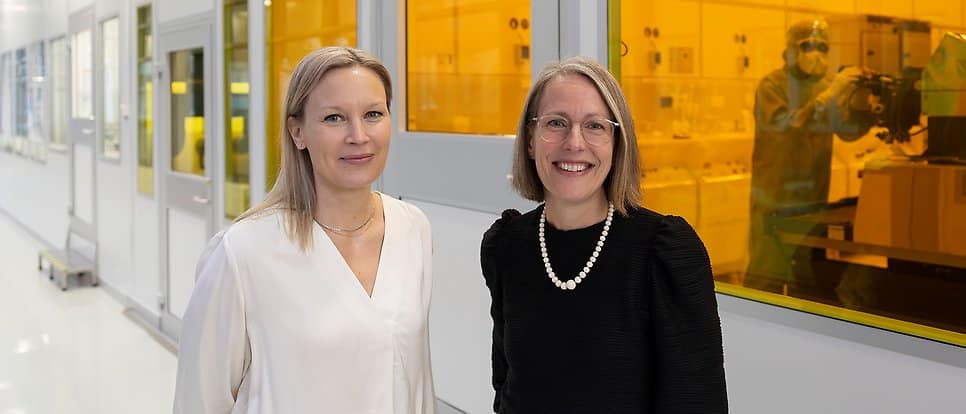
From left: Professor Cecilia Persson and Professor Maria Tenje in the cleanroom at the Ångström Laboratory, Myfab, which is used in fields such as materials science, life sciences, and micronanosystems. Photo: Mikael Wallerstedt.

A new research programme in biomedical engineering started on 1 January at the Faculty of Science and Technology. The programme is led by Cecilia Persson, Professor of Materials Science and professor responsible for the programme, and Maria Tenje, Professor of Microsystems Technology and head of division, respectively. Cecilia Persson, what is the aim of the programme?

“The aim is to find synergies in research in biomedical engineering, and advance the field by joining forces. We’ve identified four different challenges, or themes, in biomedical engineering that we are specialising in initially: Precision Health, Sustainability, Antibiotic Resistance and AI for Life Science. In these, our research leaders have different approaches, from materials science and engineering to microsystems technology and biophysics. The programme has been developed from a previous initiative with the Department’s strategic funding, and now there is also direct government funding, which has made it a longer-term initiative.”

 

Highlights and events

Online course datorskärm med teamsmöte
2026 10 15
Myfab Chalmers , Myfab , Myfab KTH , Myfab Lund , Myfab Uppsala

Digital School: MEMS: R&D Challenges and Industry Landscape

Read more
2026 10 13
Myfab , Myfab Lund , Myfab Uppsala

Two KAW-funded research projects involve Myfab

Read more
2026 10 13
Myfab Uppsala , Myfab

Donation strengthens development of future biomaterials

Read more
New technology could lead to significantly more efficient LEDs. The image is an illustration and is not related to the research described. Photo: Mostphotos.
2026 09 08
Myfab Lund

A new type of LED light could bring significant efficiency gains

Read more
See all highlights