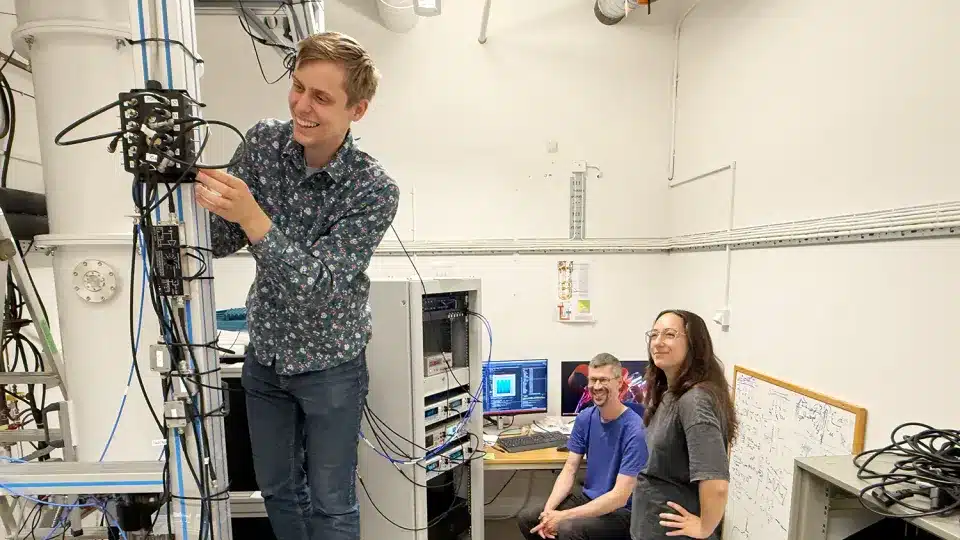

Nils Johan Engelsen, researcher at Chalmers and Myfab user, has been named one of 27 new Wallenberg Academy Fellows. The five-year grant supports outstanding young researchers in pursuing ambitious projects.
Nils Engelsen’s project will build a nanoscale platform, hundreds of times thinner than a strand of hair, where atoms and light interact at the quantum level. These quantum effects could lead to future technologies such as ultra-stable lasers, atomic clocks, quantum computers, and ultra-sensitive sensors.
The Wallenberg Academy Fellows program, funded by the Knut and Alice Wallenberg Foundation, awards long-term research grants to outstanding early-career researchers. Each Fellow receives five years of funding to tackle complex, long-term research questions and generate groundbreaking knowledge. After the initial period, an additional five years can be applied for.
The program was established in 2012 in collaboration with Sweden’s royal academies and 16 universities. Researchers are nominated by universities, evaluated by the academies, and selected by the Foundation. Grants cover a wide range of fields: natural sciences, medicine, engineering and technology, humanities, and social sciences.
Since its start, 288 researchers have been appointed Fellows, with the Foundation investing over SEK 3.2 billion in the program. It aims to retain Swedish talent and attract international researchers, providing time and resources for ambitious projects.