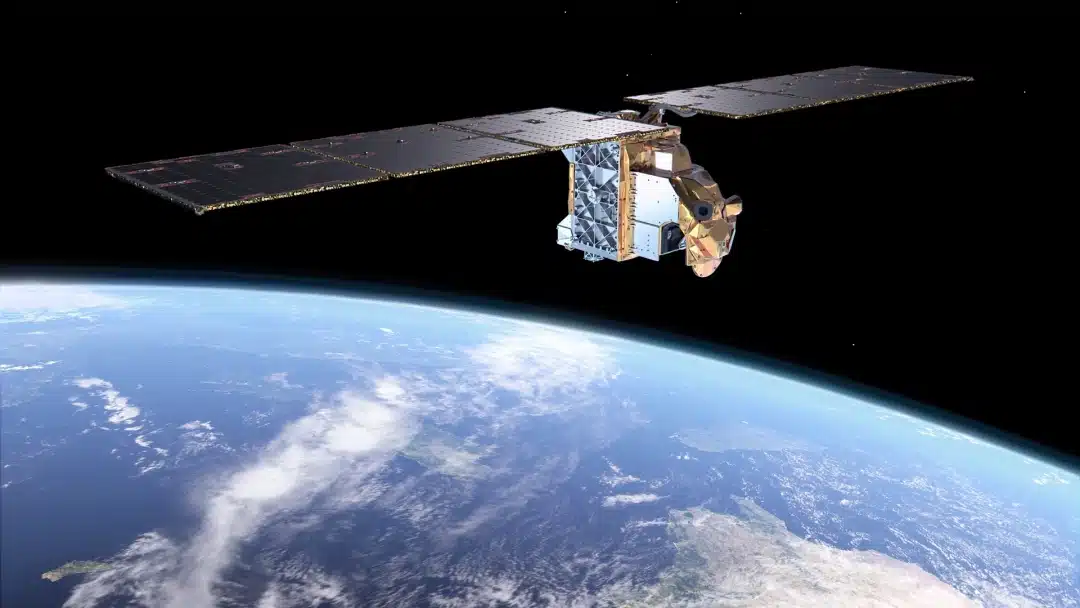
In recent years, semiconductor components and environmental measurement expertise from Chalmers have played a key role in advancing weather satellite technology. It has now been confirmed that microwave radiometers based on Chalmers research will be used in the European weather satellite programme EPS-Sterna – bringing significant benefits for future climate research.
The announcement follows a record-breaking order worth nearly SEK 820 million, placed by Swedish satellite manufacturer OHB Sweden for 20 microwave radiometers from the Gothenburg-based space company AAC Omnisys. OHB Sweden is the prime contractor for the weather satellites used within the European satellite programme EPS-Sterna, on behalf of the European Organisation for the Exploitation of Meteorological Satellites (EUMETSAT).
The satellites’ primary mission is to provide frequent measurements of atmospheric temperature and humidity for numerical weather prediction. The radiometer technology at the heart of these satellites is partly built on research and development conducted at Chalmers. The programme represents the latest milestone in a long-standing collaboration between Chalmers and the Swedish space industry, dating back to the 1990s and the development of the Odin satellite.
Patrick Eriksson, Professor of Geosciences and Remote Sensing at Chalmers, has been involved throughout the entire journey – from early research and instrument concepts to implementation and operational use.
“This is by far the largest order ever for Swedish companies in the field of satellite delivery,” says Eriksson. “This success builds on a series of national satellite initiatives and collaborations. For example, the Sterna programme would not exist without Sweden’s earlier investment in the Odin satellite, launched in 2001 and now performing its final measurements. It almost feels as if Odin held out until the Sterna contract was signed.