
Skip to content

Humidity-resistant hydrogen sensor can improve safety in large-scale clean energy

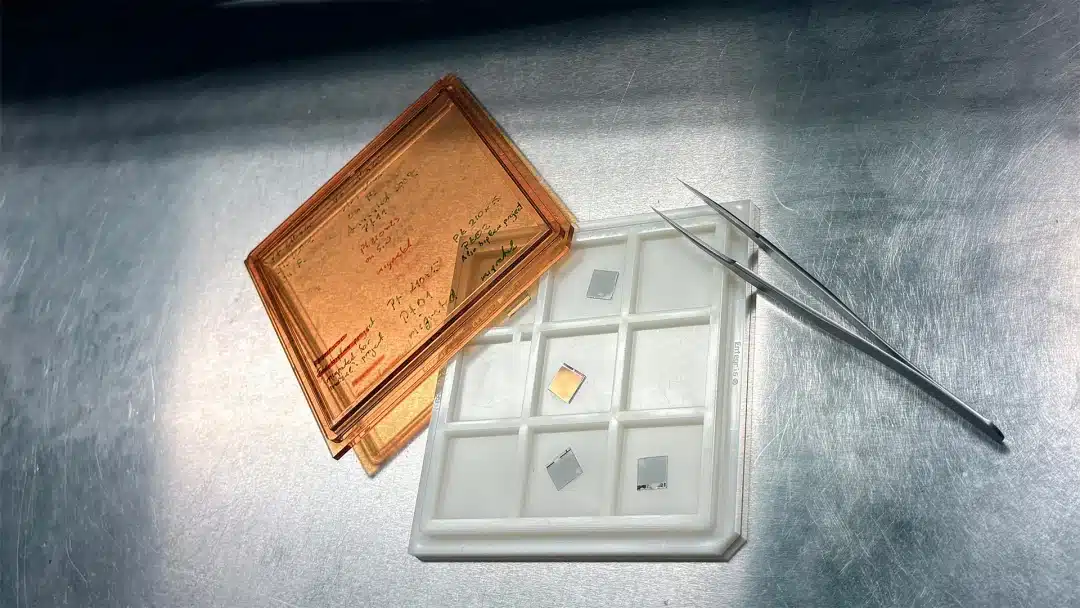
Hydrogen plays an important role in society’s energy transition. For the technology to be used on a broad scale, effective hydrogen sensors are required to prevent the formation of flammable oxyhydrogen gas when hydrogen is mixed with air. Now, researchers at Chalmers University of Technology, Sweden, can present a compact sensor that can be manufactured on a large scale and is well suited to the humid environments where hydrogen is to be found. Unlike today’s sensors, the new sensor performs better the more humid it gets. Image: Chalmers University of Technology | Mia Halleröd Palmgren

Wherever hydrogen is present, safety sensors are required to detect leaks and prevent the formation of flammable oxyhydrogen gas when hydrogen is mixed with air. It is therefore a challenge that today’s sensors do not work optimally in humid environments – because where there is hydrogen, there is very often humidity. Now, researchers at Chalmers University of Technology, Sweden, are presenting a new sensor that is well suited to humid environments – and actually performs better the more humid it gets.

“The performance of a hydrogen gas sensor can vary dramatically from environment to environment, and humidity is an important factor. An issue today is that many sensors become slower or perform less effectively in humid environments. When we tested our new sensor concept, we discovered that the more we increased the humidity, the stronger the response to hydrogen became. It took us a while to really understand how this could be possible,“ says Chalmers doctoral student Athanasios Theodoridis, who is the lead author of the article in the journal ACS Sensors.

Highlights and events

The conceptual image shows how the researchers’ sculpted pattern of tiny hills and valleys – smaller than one millionth of a hair’s thickness – on the substrate (MgO, at the bottom) guides how the atoms in the superconducting material (YBCO, on top) settle. At the interface between the two layers, an electronic landscape allows superconductivity to occur at higher temperatures than previously possible – even when high magnetic fields were are applied. Credit: Chalmers University of Technology / Riccardo Arpaia
2026 03 18
Myfab Chalmers

Superconductor advance could unlock ultra-energy-efficient electronics

Read more
Event a university house - Ångström Laboratory - Myfab Uppsala
2026 03 12
Myfab Chalmers , Myfab , Myfab KTH , Myfab Lund , Myfab Uppsala

Nordic user meeting: NNTN & NNUM in Uppsala

Read more
Illustration of the device concept. A memory chip based on stacked quantum materials. By placing a magnetic layer on top of a topological material, the researchers were able to switch magnetization using very small electrical currents and without applying an external magnetic field. Illustration: Lalit Pandey
2026 03 11
Myfab Chalmers

Quantum materials breakthrough for energy-efficient data processing

Read more
Ove Öhman has been a bridge-builder between academia and the business sector for several decades and has helped strengthen Uppsala’s innovation environment. Photo: Mikael Wallerstedt, Uppsala University
2026 03 10
Myfab Uppsala

Ove Öhman receives prize as a bridge-builder between research and innovation

Read more
See all highlights