Skip to content

Innovative fabrication method for flat magnetic nanostructures

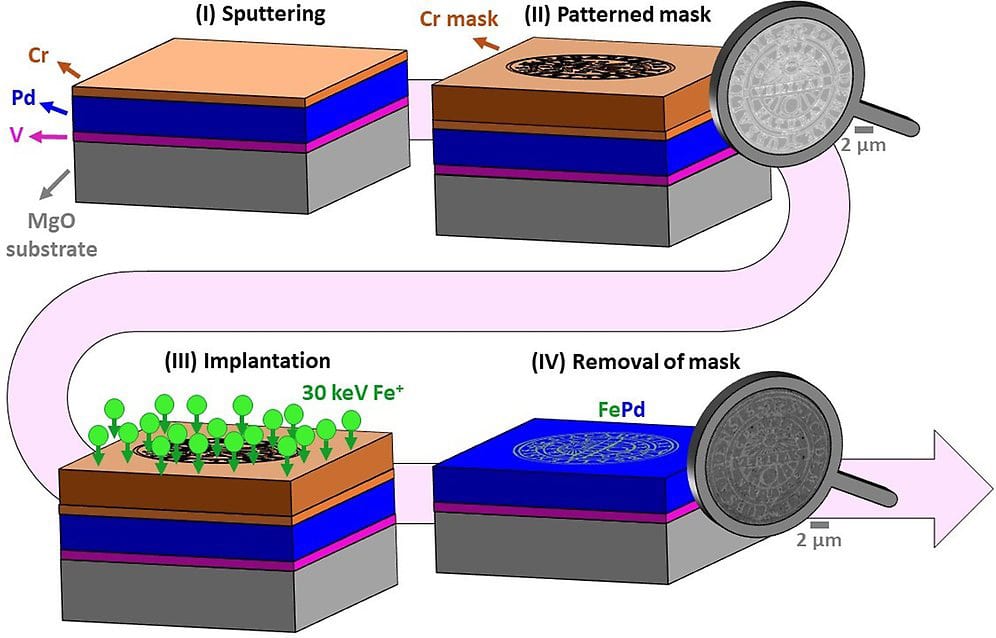
Four step process: 1. Sputtering, 2. Patterned mask, 3. Implantation, 4. Removal of mask

“These flat magnetic nanostructures present promising potential for advanced applications, including in-material computation, that is that the material itself can function as a computer, processing and calculating solutions internally, making certain types of problem-solving faster and more efficient”, says Christina Vantaraki, PhD student at the Department of Physics and Astronomy and the developer of the method.

This new way of designing nano magnets was supported through resources at the Materials Physics Division of the Department of Physics and Astronomy, MyFab Uppsala, and the Tandem Laboratory and was achieved in four steps.


Highlights and events

Harald Havir, Ville Maisi and Andrea Cicovic are three of the authors behind the recent article in Nature Communications. Photo: Evelina Lindén
2026 08 18
Myfab Lund

Driving the resonator in the nonlinear regime makes detecting faster

Read more
A neuron detects information, stores it and processes it at the same time. “The exciting thing is that the same component can function both as a sensor and as a computer,” explains Anders Mikkelsen.
2026 08 10
Myfab Lund

A neuron powered by light gives AI some of the brain’s most important traits

Read more
2026 07 01
Myfab Chalmers , Myfab

Hands-on Training on MEMS Fabrication and Characterisation at Myfab Chalmers

Read more
2026 06 24
Myfab Uppsala , Myfab

Myfab Uppsala highlighted

Read more
See all highlights