Skip to content

Light-powered motor fits inside a strand of hair

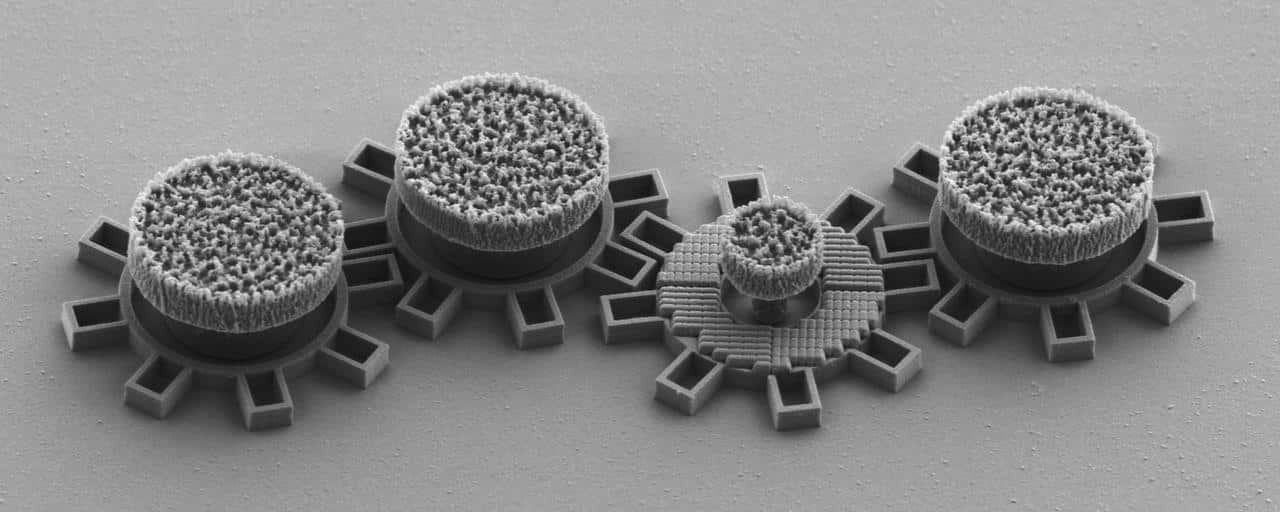
The second gear from the right has an optical metamaterial that react to laserlight and makes the gear move. All gears are made in silica directly on a chip. Each gear is about 0.016 mm in diameter.
The second gear from the right has an optical metamaterial that react to laserlight and makes the gear move. All gears are made in silica directly on a chip. Each gear is about 0.016 mm in diameter. Photo: Gan Wang

Researchers at the University of Gothenburg have made light-powered gears on a micrometer scale. This paves the way for the smallest on-chip motors in history, which can fit inside a strand of hair.

Gears are everywhere – from clocks and cars to robots and wind turbines. For more than 30 years, researchers have been trying to create even smaller gears in order to construct micro-engines. But progress stalled at 0.1 millimetres, as it was not possible to build the drive trains needed to make them move any smaller.

Researchers from Gothenburg University, among others, have now broken through this barrier by ditching traditional mechanical drive trains and instead using laser light to set the gears in motion directly.
Highlights and events

From left: Professor Cecilia Persson and Professor Maria Tenje in the cleanroom at the Ångström Laboratory, Myfab, which is used in fields such as materials science, life sciences, and micronanosystems. Photo: Mikael Wallerstedt.
2026 04 27
Myfab Uppsala

Expertise in biomedical engineering brought together in a new research programme

Read more
2026 04 15
Myfab Uppsala

Göran Gustafsson Prizes in Engineering Physics awarded to Uppsala researchers

Read more
PhD student Giulio Cavaliere at the Additive Manufacturing Lab Photo: Mikael Wallerstedt
2026 04 14
Myfab Uppsala

Innovative projects receive grant from Knut and Alice Wallenberg Foundation

Read more
Event a university house - Ångström Laboratory - Myfab Uppsala
2026 04 02
Myfab Chalmers , Myfab , Myfab KTH , Myfab Lund , Myfab Uppsala

June 1-3: Nordic user meeting in Uppsala

Read more
See all highlights