
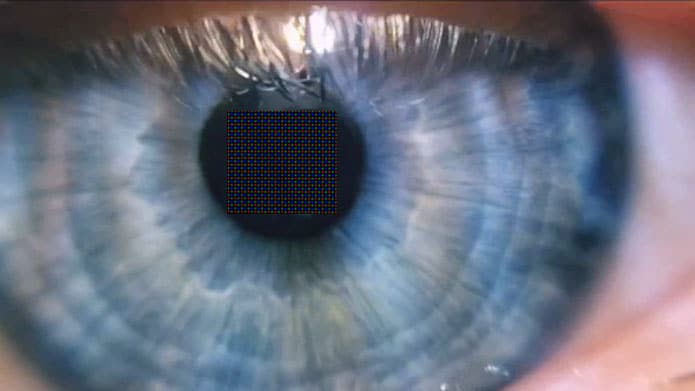
In an article in the science journal Nature, researchers from Chalmers University of Technology, the University of Gothenburg and Uppsala University, Sweden, present a technology with the smallest pixels ever, in a screen with the highest resolution possible for the human eye to perceive. The pixels reproduce colours using nanoparticles whose dimensions and arrangement control how light is scattered, and whose optical properties can be electrically tuned. This breakthrough paves the way for the creation of virtual worlds that are visually indistinguishable from reality.
As the transfer of information in our society becomes more complex, so the demand increases for screens that transmit images and video with precision.
“The technology that we have developed can provide new ways to interact with information and the world around us. It could expand creative possibilities, improve remote collaboration, and even accelerate scientific research,” says Kunli Xiong, Assistant Professor at the Department of Materials Science and Engineering at Uppsala University, who conceived the project and is the lead author of the study.
“Our results are exceptional because we achieve a higher resolution than the human eye can perceive. It will be possible to create virtual worlds that are visually indistinguishable from reality. Potential applications include ultra-realistic VR displays and highly efficient high-resolution wearable screens,” says Kunli Xiong.