Skip to content

Nanoscale movies show how to build new materials

The studies of existing materials are the first step on the way to designing completely new structures with new properties. Photo: KAW / Kennet Ruona

By studying how materials build themselves and by mimicking those processes, it is possible to create materials with new structures and properties. This is what Wallenberg Scholar Kimberly Dick Thelander, professor of materials science at Lund University, is doing.

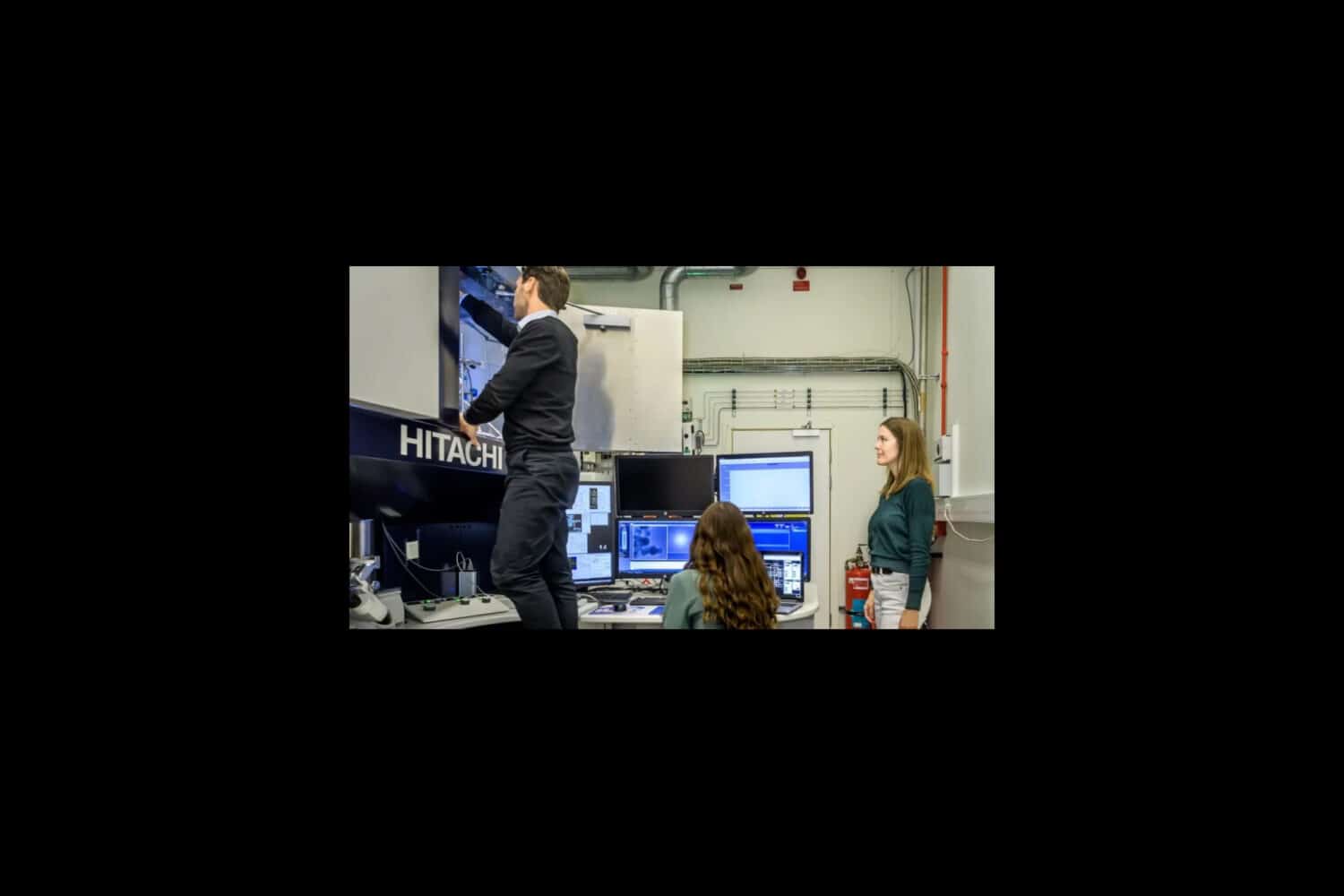
At the nano scale, which is measured in billionths of a meter, phenomena occur that do not otherwise exist. Thelander and her colleagues are studying this process while it actually takes place. This is possible thanks to an electron microscope she has been using and developing since 2016.

“Everything we wanted to do when it was new is now possible. We use the microscope every day, and it is involved in about 70 percent of our research,” she says.

The studies of existing materials are the first step on the way to designing completely new structures with new properties.

The basic material is usually a gas that spontaneously forms crystals inside a large machine. The machine contains the electron microscope, enabling the researchers to record images and film at atomic scale.

“We’re trying to understand the materials and their crystalline structures at atomic level. When we identify the processes that determine the structures and control those processes, we will also be able to control the properties.”


Highlights and events

Ove Öhman has been a bridge-builder between academia and the business sector for several decades and has helped strengthen Uppsala’s innovation environment. Photo: Mikael Wallerstedt, Uppsala University
2026 03 10
Myfab Uppsala

Ove Öhman receives prize as a bridge-builder between research and innovation

Read more
A research team at Chalmers University of Technology has developed a new diminutive laser technology that makes it possible to create a miniature biosensor with the laser source and optics integrated onto a one-centimetre semiconductor chip. This enables significantly smaller sensors, paving the way for portable optical technology and for moving certain types of medical sampling from hospitals to the patients’ homes. Illustration: Chalmers/Erik Strandberg
2026 03 10
Myfab Chalmers

Miniature laser technology could bring lab testing into your home

Read more
Event a university house - Ångström Laboratory - Myfab Uppsala
2026 02 25
Myfab Chalmers , Myfab , Myfab KTH , Myfab Lund , Myfab Uppsala

Register latest March 15: NNTN & NNUM in Uppsala

Read more
2026 02 24
Myfab KTH

KISAB speeds development of key clean‑energy materials with Myfab KTH’s support

Read more
See all highlights