
Skip to content

Superconductor advance could unlock ultra-energy-efficient electronics

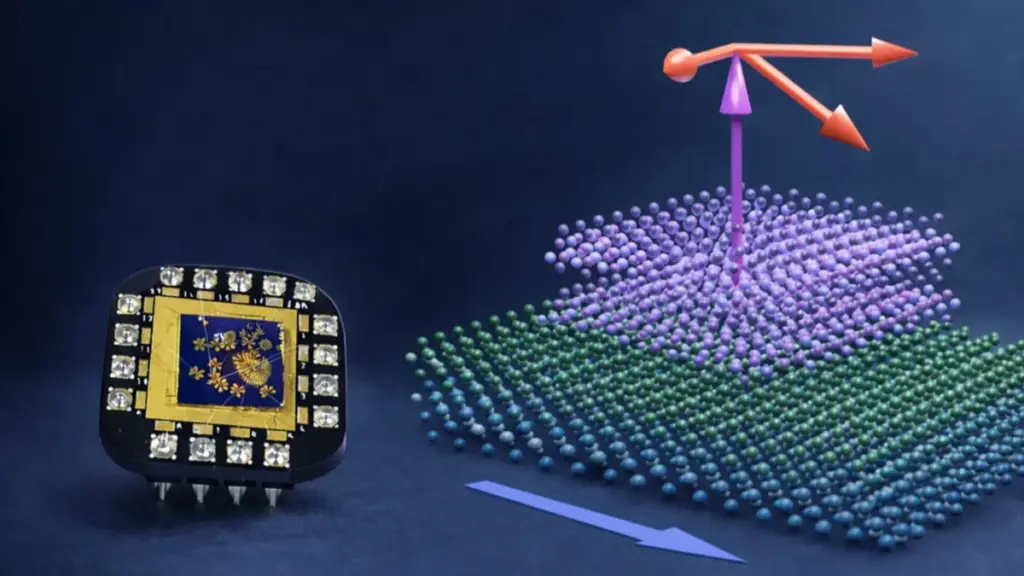
The conceptual image shows how the researchers’ sculpted pattern of tiny hills and valleys – smaller than one millionth of a hair’s thickness – on the substrate (MgO, at the bottom) guides how the atoms in the superconducting material (YBCO, on top) settle. At the interface between the two layers, an electronic landscape allows superconductivity to occur at higher temperatures than previously possible – even when high magnetic fields were are applied. Credit: Chalmers University of Technology / Riccardo Arpaia

Superconducting materials could play a crucial role in the energy-efficient applications of the future. However, several technical challenges still stand in the way of their practical use. Now, researchers at Chalmers University of Technology in Sweden have developed a new material design that addresses a major obstacle in the field: enabling superconductivity to operate at higher temperatures while also withstanding strong magnetic fields. This breakthrough could pave the way for far more energy-efficient electronics and quantum technologies.

Digital devices, data centres and information and communications technology (ICT) networks currently account for approximately 6 to 12 per cent of global electricity consumption. There is a substantial and growing need for more energy-efficient electronics and this is where superconducting materials have emerged as a promising solution. Unlike conventional electronics, which lose energy as heat, superconductors can conduct electricity with zero energy loss. Thus, superconductors have the potential to make power grids, electronics and quantum technologies hundreds of times more energy efficient.

However, the path to real-world applications is still blocked by several key challenges. One major obstacle is that superconducting states often require extremely low temperatures – down to around minus 200 degrees Celsius. Cooling to such temperatures is complex and energy-intensive. Another major challenge is that superconductivity can be weakened or destroyed by strong magnetic fields. This is a critical limitation, as magnetic fields are often present in advanced electronic devices and are essential to many quantum technologies. For superconducting technology to move beyond the laboratory and into practical use, materials are therefore needed that can maintain superconductivity at higher temperatures – ideally close to room temperature –while also remaining robust under strong magnetic fields.


Highlights and events

The world’s first Arctic weather satellite was launched into orbit in 2024. Now, the Chalmers-based technology used in the satellite’s microwave radiometers will be deployed in Europe’s new weather satellite programme, EPS-Sterna. Image: European Space Agency
2026 03 27
Myfab Chalmers

Chalmers research at the heart of record order for Europe’s new weather satellites

Read more
Event
2026 03 23
Myfab Chalmers , Myfab , Myfab KTH , Myfab Lund , Myfab Uppsala

April 15: Myfab joins SEMICON 2026

Read more
Event a university house - Ångström Laboratory - Myfab Uppsala
2026 03 12
Myfab Chalmers , Myfab , Myfab KTH , Myfab Lund , Myfab Uppsala

June 1-3: Nordic user meeting in Uppsala

Read more
Illustration of the device concept. A memory chip based on stacked quantum materials. By placing a magnetic layer on top of a topological material, the researchers were able to switch magnetization using very small electrical currents and without applying an external magnetic field. Illustration: Lalit Pandey
2026 03 11
Myfab Chalmers

Quantum materials breakthrough for energy-efficient data processing

Read more
See all highlights