Skip to content

2DSPIN-TECH: a game changer for future computer memory

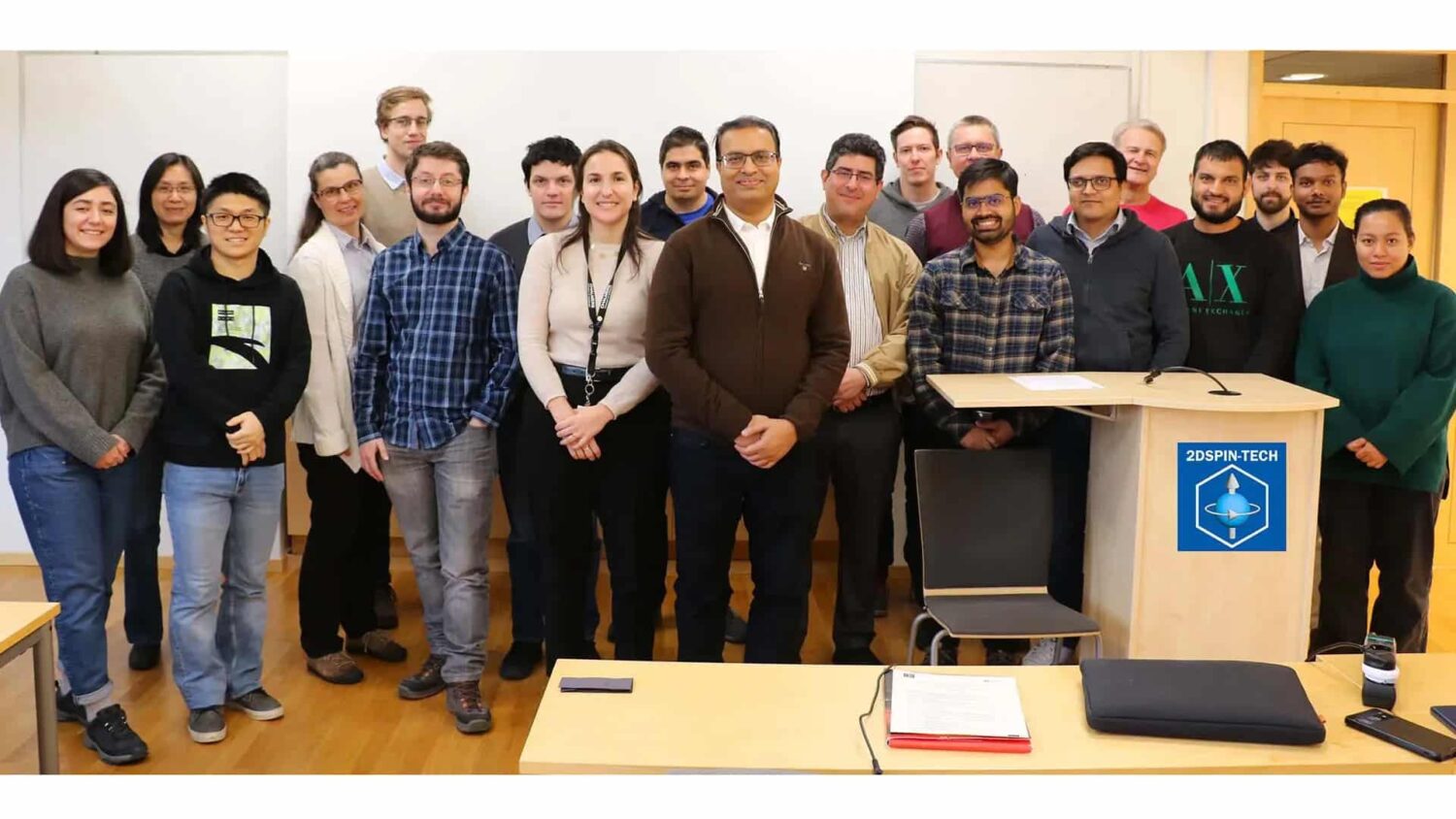
Group picture from 2DSPIN-TECH

By harnessing the features of several new two-dimensional quantum materials, researchers within the EU project 2DSPIN-TECH wish to pave the way for significantly faster and more energy-efficient computer memories. “This is crucial for the future use of information technology,” says Saroj Dash, coordinator of 2DSPIN-TECH.

Last week, the kickoff event took place for the newly launched EU Horizon project 2DSPIN-TECH, which, with seven partners and €4 million in funding, aims to contribute to the development of next-generation memory technologies. The project spans three years and is conducted within the framework of the EU’s Graphene Flagship, a multibillion-dollar initiative launched over a decade ago to stimulate research and innovation in graphene and other two-dimensional materials.


Highlights and events

New technology could lead to significantly more efficient LEDs. The image is an illustration and is not related to the research described. Photo: Mostphotos.
2026 09 08
Myfab Lund

A new type of LED light could bring significant efficiency gains

Read more
Harald Havir, Ville Maisi and Andrea Cicovic are three of the authors behind the recent article in Nature Communications. Photo: Evelina Lindén
2026 08 18
Myfab Lund

Driving the resonator in the nonlinear regime makes detecting faster

Read more
A neuron detects information, stores it and processes it at the same time. “The exciting thing is that the same component can function both as a sensor and as a computer,” explains Anders Mikkelsen.
2026 08 10
Myfab Lund

A neuron powered by light gives AI some of the brain’s most important traits

Read more
2026 07 01
Myfab Chalmers , Myfab

Hands-on Training on MEMS Fabrication and Characterisation at Myfab Chalmers

Read more
See all highlights