Skip to content

Miniature laser technology could bring lab testing into your home

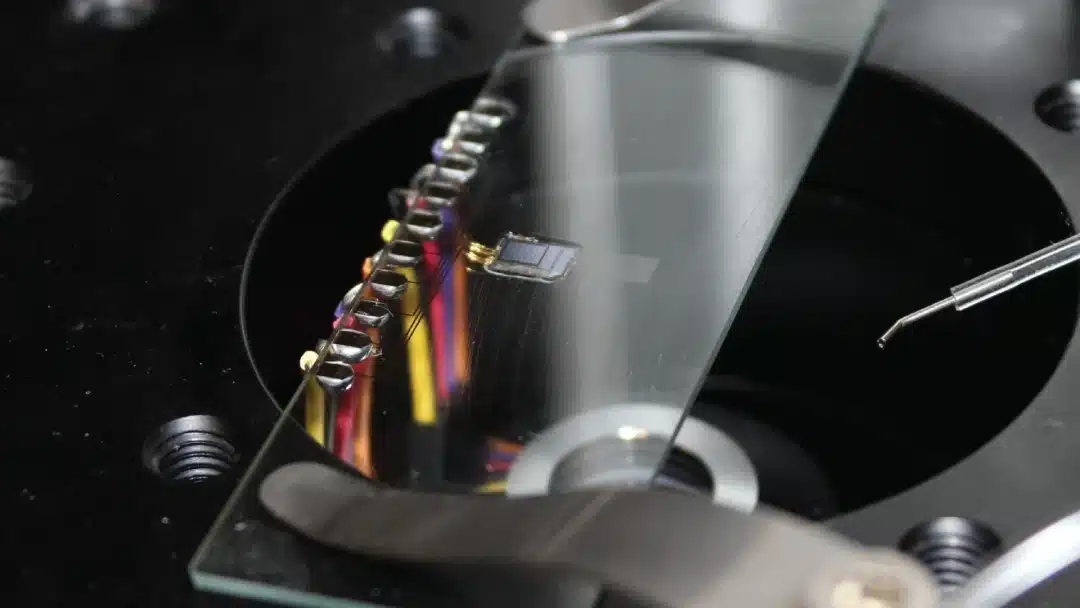
A research team at Chalmers University of Technology has developed a new diminutive laser technology that makes it possible to create a miniature biosensor with the laser source and optics integrated onto a one-centimetre semiconductor chip. This enables significantly smaller sensors, paving the way for portable optical technology and for moving certain types of medical sampling from hospitals to the patients’ homes. Illustration: Chalmers/Erik Strandberg

A research team at Chalmers University of Technology, Sweden, has developed new laser technology that could lead to tiny, cost-effective biosensors. The sensors integrate lasers and optics together on a centimeter-sized chip, which could move testing from hospitals to patients’ homes. This, in turn, would free up hospital beds and reduce visits to clinics.

By studying how various biomolecules interact with each other – for example antibodies in the immune system and xenobiotic antigens – researchers can gain valuable insights leading to new medicines and vaccines or assess whether a sample contains signs of infection.

Optical biosensors based on a technique called surface-plasmon resonance are an important tool used for studying these types of interactions. The sensors direct light onto a gold surface and measure minuscule changes in the light’s reflection when biomolecules are placed on the surface.

Now, a research team at Chalmers is announcing a new laser technology that makes it possible to create such biosensors in a miniature format. The laser source and the necessary optics are directly integrated onto a semiconductor chip, allowing for significantly more compact sensors. This opens the door to making optical sensing technology portable and applicable outside the laboratory environment.

Highlights and events

Ove Öhman has been a bridge-builder between academia and the business sector for several decades and has helped strengthen Uppsala’s innovation environment. Photo: Mikael Wallerstedt, Uppsala University
2026 03 10
Myfab Uppsala

Ove Öhman receives prize as a bridge-builder between research and innovation

Read more
Event a university house - Ångström Laboratory - Myfab Uppsala
2026 02 25
Myfab Chalmers , Myfab , Myfab KTH , Myfab Lund , Myfab Uppsala

Register latest March 15: NNTN & NNUM in Uppsala

Read more
2026 02 24
Myfab KTH

KISAB speeds development of key clean‑energy materials with Myfab KTH’s support

Read more
2026 02 05
Myfab Chalmers

Humidity-resistant hydrogen sensor can improve safety in large-scale clean energy

Read more
See all highlights