Enhancing cancer treatment by improving how therapeutic nanoparticles enter and act within cells is a promising direction. Christelle Prinz and her team have shown that photothermal therapy is more effective when the nanoparticles target the endoplasmic reticulum, which is achieved by performing nanostraw injections.
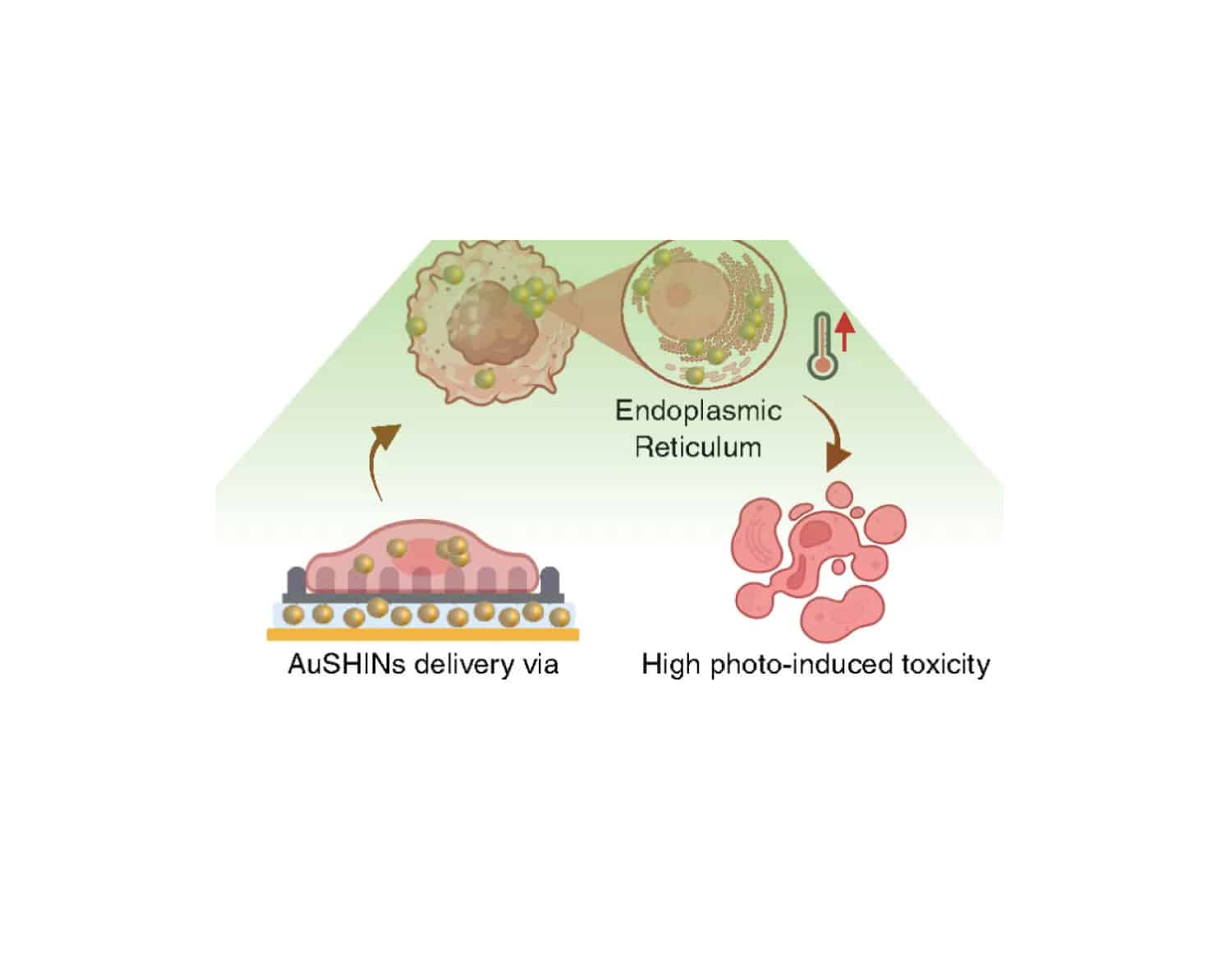
Gold nanoparticles, especially a type called AuSHINs, show great promise for treating cancer using heat (a method known as photothermal therapy, or PTT). These particles are small, stable, safe for the body, and can be customized in size and shape. But there’s a problem: when added to cancer cells in the lab, they often don’t work as well as hoped. That’s because the cells don’t absorb enough of them, and many end up trapped in parts of the cell (lysosomes) where they break down and lose their effect.
Testing on human breast cancer cells
In this study, researchers tried a new way to deliver these gold particles by using nanostraws to inject them directly into the cells. They compared this method to the usual approach of simply soaking the cells in a solution containing the particles. The tests were done on two types of human breast cancer cells: one aggressive (MDA-MB-231) and one less aggressive (MCF7).
The results were clear: nanostraw injection got about 10 times more particles into the cells. Plus, instead of ending up in lysosomes where they could degrade, the particles reached another part of the cell – the endoplasmic reticulum – which helped them stay intact and more effective.
Nanostraw-delivered phototermal therapy improves treatment
As a result, cancer cells treated with the nanostraw-delivered particles were about twice as likely to die after light activation compared to the regular method. The treatment worked better on the MCF7 cells, while the MDA-MB-231 cells were more resistant.
These findings suggest that using nanostraws to deliver gold nanoparticles could significantly improve cancer treatment with PTT. The next big step is figuring out how to use this method safely and effectively in living organisms.