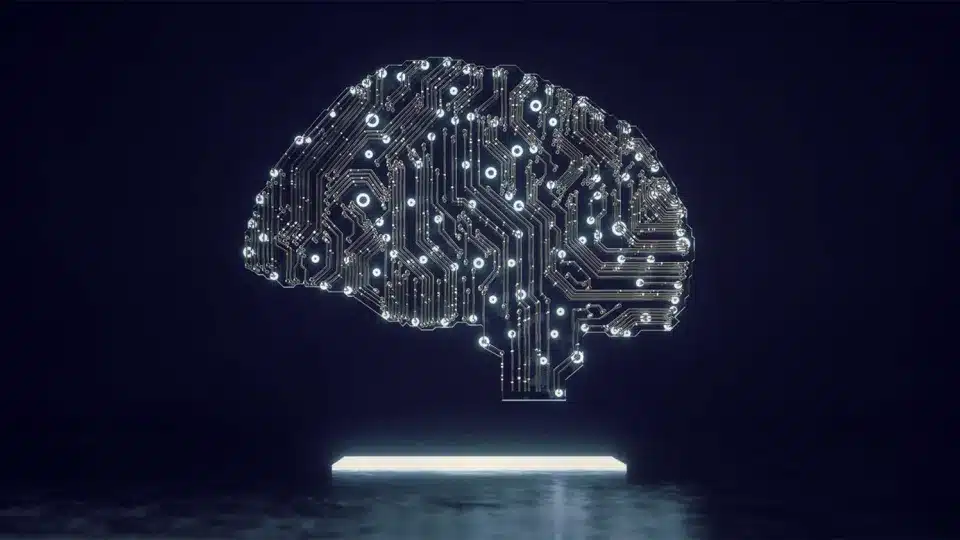
AI requires ever-larger data centres and ever more power. Now, researchers have developed an artificial neuron that operates using light and brings together several of the brain’s most important functions in a single component. The technology could eventually pave the way for more energy-efficient AI and intelligent sensors.
Training today’s largest AI models requires enormous data centres filled with processors that consume power around the clock. Some analyses predict that, in the coming years, AI could account for a significant share of the world’s growing electricity consumption.
Photo of a man wearing glasses.
“One of the most fascinating things about biological visual systems is that they do not just register the world. They start interpreting it straight away,” says Anders Mikkelsen.
Meanwhile, the human brain performs tasks that still challenge even the most advanced AI systems while consuming just 20 watts of power – roughly the same as an LED bulb.
“The transistors we use today are actually incredibly energy-efficient. The problem is that information has to be moved back and forth between them and the memory all the time. It is the transport of information that consumes energy. The brain works differently. Here, computation, memory and communication take place within the same networks of connections,” says Anders Mikkelsen, who led the new study together with colleagues from Lund University in Sweden and the University of Copenhagen in Denmark.