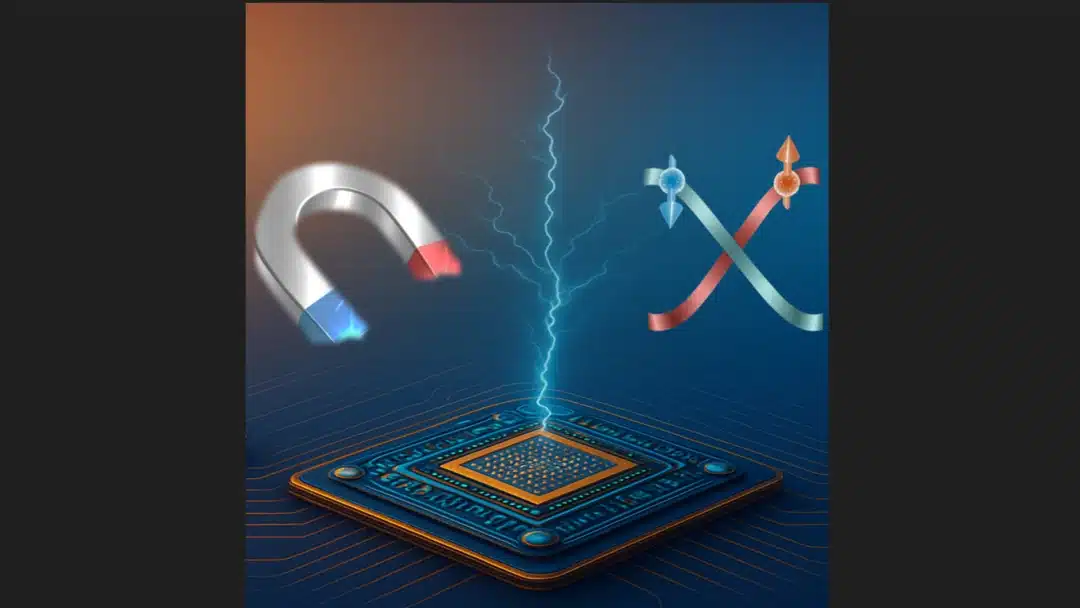
The European Innovation Council research project AMSwitch has been awarded SEK 30 million in funding to explore how a new spin degree of freedom in novel magnetic states could replace electric charge as the information carrier in electronic components. The goal is to realize faster, more secure, and ultra-energy-efficient data processing – offering a possible path beyond the limitations of today’s memory or transistors.
The European Innovation Council (EIC) recently announced the results of the EIC Pathfinder Open 2025 call, awarding nearly SEK 1.5 billion to research projects with the potential to turn visionary ideas into innovations for future markets.
The 2025 call attracted record interest from the research community, with applications from 71 countries. Out of a total of 2,087 proposals, 44 projects were selected for funding, with a success rate of only 2%. Each project will receive approximately SEK 30 million to explore breakthrough ideas in areas such as quantum technologies, advanced materials, health, energy, and artificial intelligence. Among the selected projects are two from Swedish universities, including AMSwitch, which is coordinated by the Department of Microtechnology and Nanoscience at Chalmers University of Technology. With the grant of around SEK 30 million, the research team will investigate a completely new way of storing and processing information in electronic components – using a new magnetic state called Altermagnets.
“Receiving this highly competitive grant from the European Innovation Council (EIC) to coordinate AMSwitch is an important milestone – both for our consortium and for the field of spin and quantum science and technologies. Now we aim to demonstrate that our bold scientific vision holds true: that symmetry-controlled altermagnetic phenomena can fundamentally reshape how we compute and build the computers of the future,” says Saroj Dash, Professor of Quantum Device Physics at Chalmers and coordinator of the project.