Skip to content

Making conductive polymer nanowires to probe cells
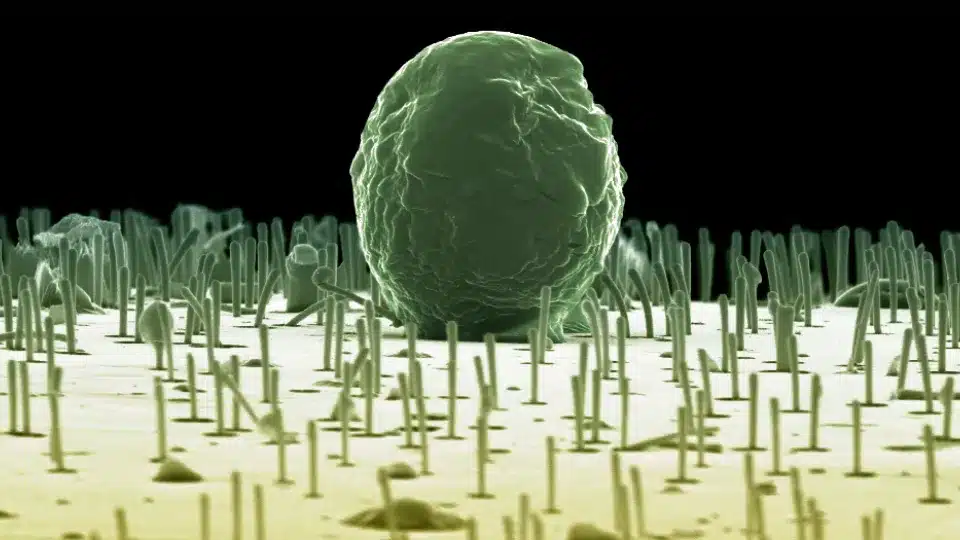
Electron microscopy image of algae sitting on the nanowires. Picture: Martin Hjort
Polymer nanowires remain conductive after lithography-free manufacturing enabling an excellent path for intracellular bioelectronic manipulation of stem cells and algae. A new study spearheaded by NanoLundians Damien Hughes and Martin Hjort presents a simple, yet efficient way to bring conductive polymers into a nanowire shape suitable to interface with living cells – and even allowing them to get really cozy together!

Highlights and events

2026 04 14
Myfab Uppsala

Innovative projects receive grant from Knut and Alice Wallenberg Foundation

Read more
Event a university house - Ångström Laboratory - Myfab Uppsala
2026 04 02
Myfab Chalmers , Myfab , Myfab KTH , Myfab Lund , Myfab Uppsala

June 1-3: Nordic user meeting in Uppsala

Read more
The world’s first Arctic weather satellite was launched into orbit in 2024. Now, the Chalmers-based technology used in the satellite’s microwave radiometers will be deployed in Europe’s new weather satellite programme, EPS-Sterna. Image: European Space Agency
2026 03 27
Myfab Chalmers

Chalmers research at the heart of record order for Europe’s new weather satellites

Read more
Event
2026 03 23
Myfab Chalmers , Myfab , Myfab KTH , Myfab Lund , Myfab Uppsala

April 15: Myfab joins SEMICON 2026

Read more
See all highlights