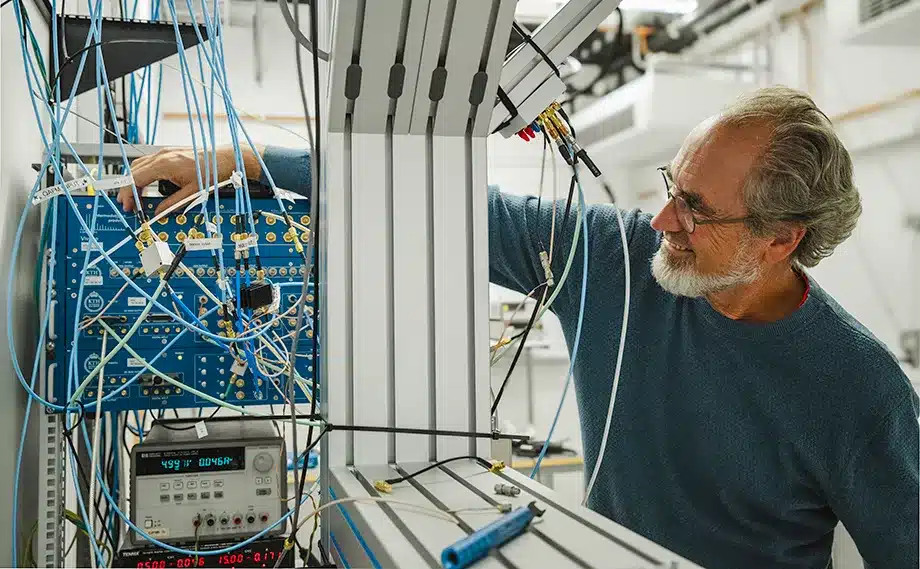
The super machine of the future, the quantum computer, is taking the step from theory to reality. At KTH, research is being conducted on everything from how the hardware itself should be built to what problems a quantum computer can actually solve.
Quantum computers are believed to be able to solve problems that even the most powerful supercomputers cannot calculate. By utilising the laws of quantum physics, the possibility of breakthroughs in many areas of research is opening, from medical development and materials research to cyber security.
“Quantum technology may affect all parts of society that are dependent on information. Directly or indirectly, the technology can affect virtually everything,” says David Haviland, professor of nanostructure physics at KTH.
Among other things, quantum technology can enable faster development of new pharmaceuticals and materials, provide more accurate forecasts in climate research, and further accelerate AI development. At the same time, quantum-security encryption can provide stronger protection for our most sensitive systems.
Creat “superqubit”
The road to the quantum computer is fraught with challenges. The biggest challenge has to do with the fragility of the quantum state. Unlike ordinary computers, where information is stored as ones and zeros, quantum computers use quantum bits (qubits). Their unique properties – being able to exist in many states at the same time – can easily be destroyed by the slightest disturbance from the environment.
“Right now, the research community seems to agree that we need to implement something called quantum error correction in order to create a usable quantum computer,” says David Haviland.
Some progress has been made by creating a kind of ‘superqubit’ where several qubits work together to compensate for environmental disturbance, which is seen as proof that quantum error correction works in practice.