Skip to content

Sweden’s news editorial SVT visited Myfab Chalmers

SVT visits Myfab Chalmers

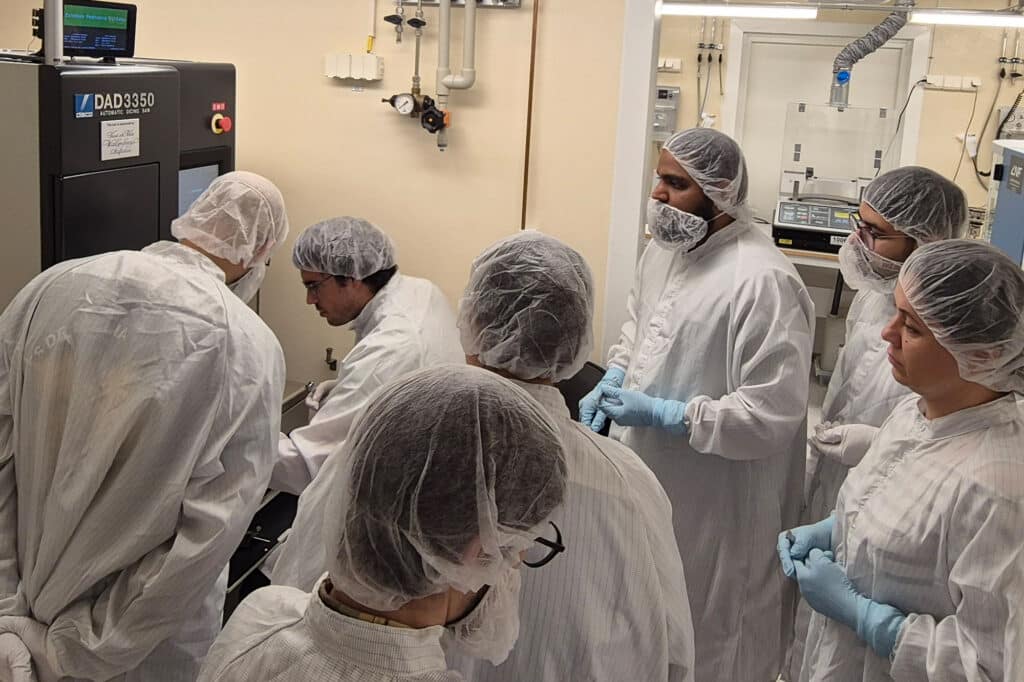
Sweden’s news editorial SVT visited Myfab Chalmers, highlighting the high demand for Chalmers University’s dust-free lab in Gothenburg, which plays a crucial role in semiconductor research. Semiconductors are essential for modern technology, and Europe aims to reduce its dependence on Taiwan, China, and the USA. 

As Europe aims to become more self-sufficient in semiconductor production, a special lab at Chalmers plays a key role. In a completely dust-free environment, researchers and companies develop semiconductor components that are fundamental to all modern technology. Interest in the lab is growing larger and larger.

In the summer of 2023, the EU adopted the Semiconductor Regulation – the so-called European Chips Act. The new rules aim to double the EU’s global market share for semiconductors from 10 percent to at least 20 percent by 2030.

The cleanroom, which is likely to be Gothenburg’s and Western Sweden’s cleanest place, is part of Myfab. It is a national research resource that also includes three similar laboratories. These are located at the universities in Lund and Uppsala, as well as at KTH in Stockholm.

In the clip, you can follow along inside Chalmers’ cleanroom.

The chip often contains silicon, a so-called semiconductor material, which does not conduct electricity as well as conductors but does not completely exclude electrical conduction like an insulator.Common to many semiconductors is that part of the material is doped to create so-called pn-junctions.

There are many types of semiconductor components, the most common being diodes, transistors, and thyristors. The areas of application have increased as technology has developed.
Highlights and events

The conceptual image shows how the researchers’ sculpted pattern of tiny hills and valleys – smaller than one millionth of a hair’s thickness – on the substrate (MgO, at the bottom) guides how the atoms in the superconducting material (YBCO, on top) settle. At the interface between the two layers, an electronic landscape allows superconductivity to occur at higher temperatures than previously possible – even when high magnetic fields were are applied. Credit: Chalmers University of Technology / Riccardo Arpaia
2026 03 18
Myfab Chalmers

Superconductor advance could unlock ultra-energy-efficient electronics

Read more
Event a university house - Ångström Laboratory - Myfab Uppsala
2026 03 12
Myfab Chalmers , Myfab , Myfab KTH , Myfab Lund , Myfab Uppsala

Nordic user meeting: NNTN & NNUM in Uppsala

Read more
Illustration of the device concept. A memory chip based on stacked quantum materials. By placing a magnetic layer on top of a topological material, the researchers were able to switch magnetization using very small electrical currents and without applying an external magnetic field. Illustration: Lalit Pandey
2026 03 11
Myfab Chalmers

Quantum materials breakthrough for energy-efficient data processing

Read more
Ove Öhman has been a bridge-builder between academia and the business sector for several decades and has helped strengthen Uppsala’s innovation environment. Photo: Mikael Wallerstedt, Uppsala University
2026 03 10
Myfab Uppsala

Ove Öhman receives prize as a bridge-builder between research and innovation

Read more
See all highlights