Skip to content

A platform of gold reveals the forces of nature’s invisible glue

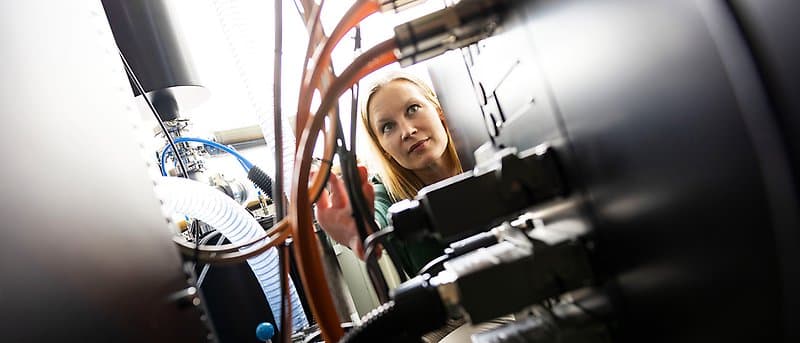
Researchers at Chalmers have discovered a quick and easy way to study the hidden forces that bind the smallest objects in the universe together. Photo: Mia Halleröd Palmgren

When dust sticks to a surface or a lizard sits on a ceiling, it is due to ‘nature’s invisible glue’. Researchers at Chalmers University of Technology, Sweden, have now discovered a quick and easy way to study the hidden forces that bind the smallest objects in the universe together. Using gold, salt water and light, they have created a platform on which the forces can be seen through colours.

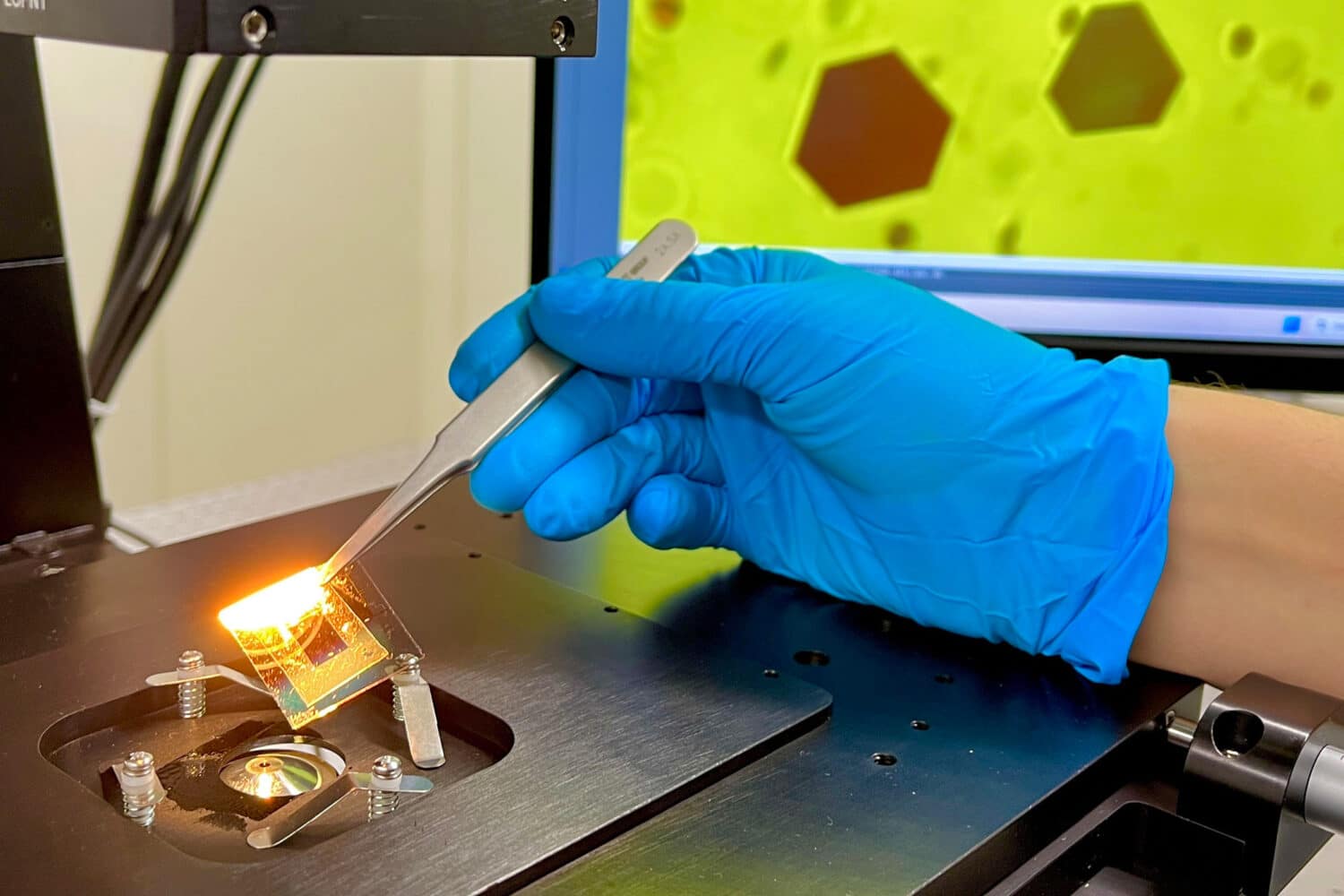
In the lab at Chalmers, doctoral student Michaela Hošková shows a glass container filled with millions of micrometre-sized gold flakes in a salt solution. Using a pipette, she picks up a drop of the solution and places it on a gold-coated glass plate in an optical microscope. What happens is that the gold flakes in the salt solution are immediately attracted to the substrate but leave nanometre-sized optical spaces between them and the gold substrate. The cavities created in the liquid act as resonators in which light bounces back and forth, displaying colours. When the microscope’s halogen lamp illuminates the platform and a spectrometer separates the wavelengths, the different colours of light can be identified. On the monitor which is connected to the lab equipment, it is now possible to see many flakes moving and changing to colours like red and green against the golden yellow background.


Highlights and events

Event a university house - Ångström Laboratory - Myfab Uppsala
2026 02 09
Myfab Chalmers , Myfab , Myfab KTH , Myfab Lund , Myfab Uppsala

Nordic user and technician meetings to Myfab Uppsala

Read more
2026 02 05
Myfab Chalmers

Humidity-resistant hydrogen sensor can improve safety in large-scale clean energy

Read more
2026 01 29
Myfab Chalmers

Novel quantum refrigerator benefits from problematic noise

Read more
AMSwitch proposed an altermagnetic chip that harnesses a new class of quantum magnetic materials called altermagnets, distinguished by their alternating and huge spin-split electronic states. The schematics depict the chip alongside a magnet (left) and a band structure (right) revealing a pronounced spin splitting between the up-spin (red) and down-spin (blue) electronic bands.
2026 01 23
Myfab Chalmers

Major EU funding for new generation of quantum magnetic chips

Read more
See all highlights