Skip to content

Humidity-resistant hydrogen sensor can improve safety in large-scale clean energy

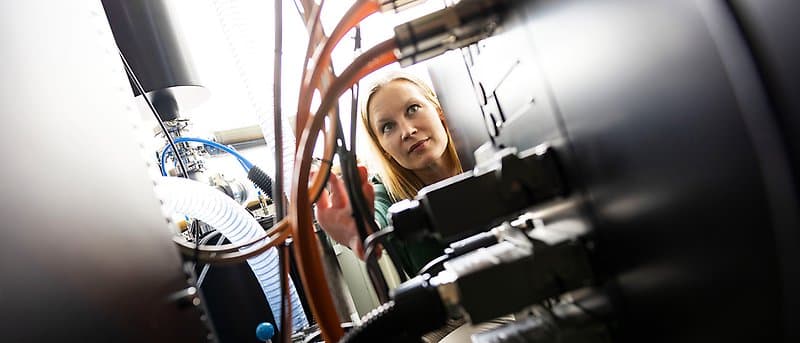
Hydrogen plays an important role in society’s energy transition. For the technology to be used on a broad scale, effective hydrogen sensors are required to prevent the formation of flammable oxyhydrogen gas when hydrogen is mixed with air. Now, researchers at Chalmers University of Technology, Sweden, can present a compact sensor that can be manufactured on a large scale and is well suited to the humid environments where hydrogen is to be found. Unlike today’s sensors, the new sensor performs better the more humid it gets. Image: Chalmers University of Technology | Mia Halleröd Palmgren

Wherever hydrogen is present, safety sensors are required to detect leaks and prevent the formation of flammable oxyhydrogen gas when hydrogen is mixed with air. It is therefore a challenge that today’s sensors do not work optimally in humid environments – because where there is hydrogen, there is very often humidity. Now, researchers at Chalmers University of Technology, Sweden, are presenting a new sensor that is well suited to humid environments – and actually performs better the more humid it gets.

“The performance of a hydrogen gas sensor can vary dramatically from environment to environment, and humidity is an important factor. An issue today is that many sensors become slower or perform less effectively in humid environments. When we tested our new sensor concept, we discovered that the more we increased the humidity, the stronger the response to hydrogen became. It took us a while to really understand how this could be possible,“ says Chalmers doctoral student Athanasios Theodoridis, who is the lead author of the article in the journal ACS Sensors.

Highlights and events

2026 05 12
Myfab , Myfab Chalmers , Myfab KTH , Myfab Lund , Myfab Uppsala

Excellence cluster applications – Myfab plays a key role

Read more
2026 05 07
Myfab

Europe’s nanofabrication network, EuroNanoLab, meets in Leuven

Read more
2026 05 05
Myfab

Interview with Thomas Swahn highlights Myfab’s role – Semiconductor 2026

Read more
From left: Professor Cecilia Persson and Professor Maria Tenje in the cleanroom at the Ångström Laboratory, Myfab, which is used in fields such as materials science, life sciences, and micronanosystems. Photo: Mikael Wallerstedt.
2026 04 27
Myfab Uppsala

Expertise in biomedical engineering brought together in a new research programme

Read more
See all highlights