
When it comes to choosing the word of the year, quantum is a strong candidate. Not only is quantum mechanics celebrating its 100th anniversary in 2025, but this year’s Nobel Prize in Physics is also awarded for research into quantum mechanical phenomena. But what is the key to successful quantum experiments? In a lab at the Ångström Laboratory, a unique type of refrigerator can drive breakthroughs.
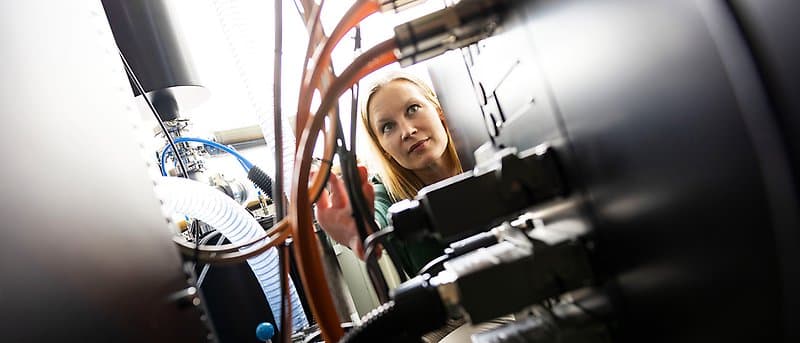
The slim, oblong unit occupies about half of the lab space, including its adjacent measuring station. Nothing reveals that the equipment has a unique capability: to reveal quantum phenomena at a previously unattainable level. This instrument, called dilution refrigerator, has the ability to cool samples to temperatures colder than the coldest regions of the universe, close to absolute zero. These extreme conditions enable researchers to observe and track quantum phenomena with a precision that was previously impossible.
This, according to Venkata Kamalakar Mutta, senior lecturer in quantum technology and Director of the Quantum Materials Device (QMD) lab.
“The dilution refrigerator provides us with the conditions we need to make groundbreaking discoveries in quantum materials and quantum matter, individual quantum systems, and quantum components for future technologies. We’ve been waiting for this new ‘toy’ for a long time, which we’ve given the name ELSA,” says Venkata Kamalakar Mutta with a smile.
ELSA, or the Emergent Low-Temperature Spin Phenomena Lab, is a milestone in the expansion of the QMD lab because of its unique capabilities in Sweden. The work at QMD is also connected to Myfab Uppsala, which is part of a national research infrastructure for microtechnology, nanoscience and materials research.
“Together with ELSA and our existing experimental capabilities at QMD and the Ångström Laboratory, Uppsala University is now one of the finest experimental environments for quantum research in the Nordic countries,” he adds.