
Skip to content

Novel quantum refrigerator benefits from problematic noise

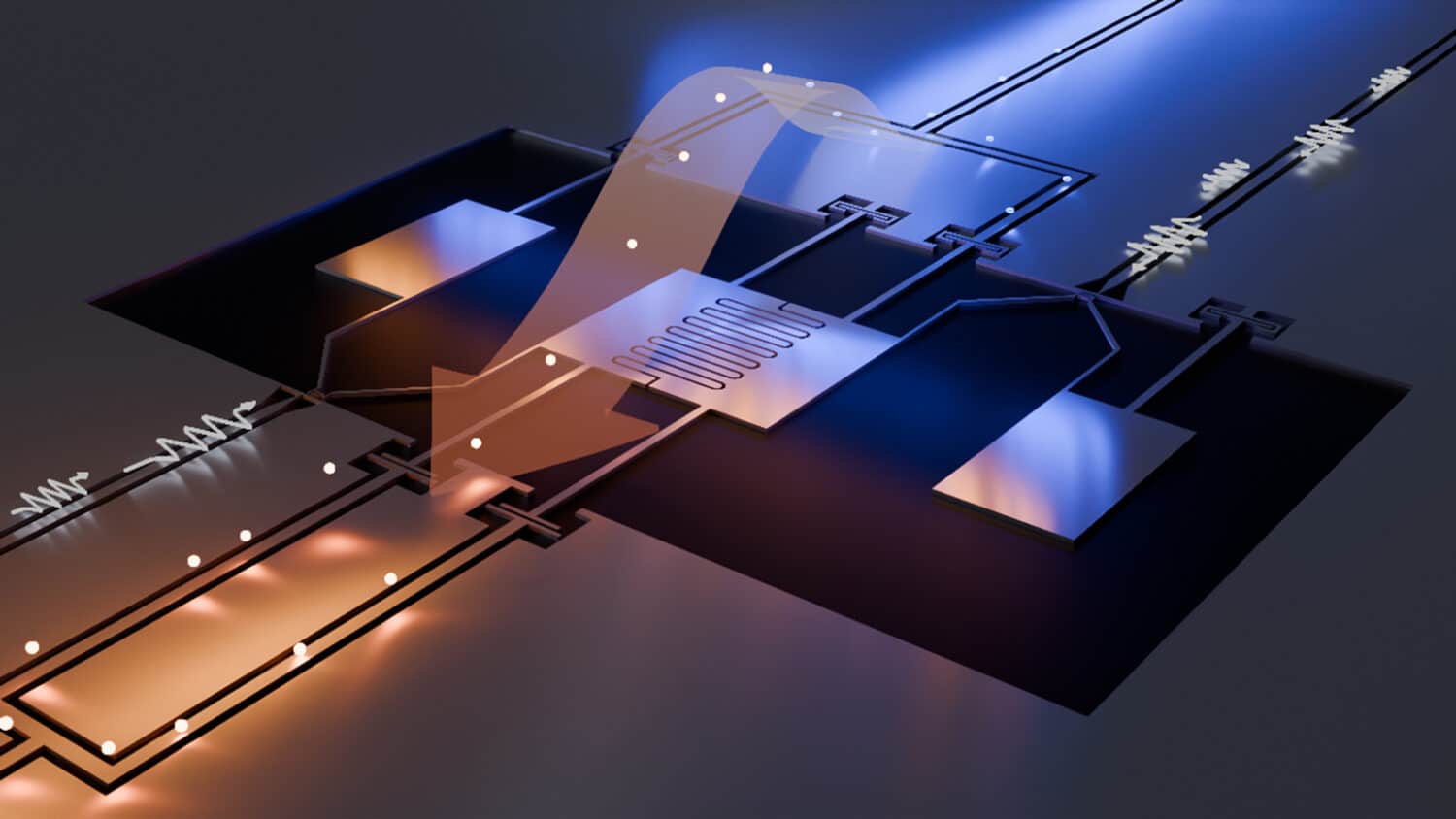
Schematic illustration of the quantum refrigerator in a superconducting quantum circuit. Two microwave channels act as hot and cold heat reservoirs, highlighted by a reddish and a bluish glow, respectively. The heat reservoirs are coupled to an artificial molecule consisting of two qubits. Controlled microwave noise (white zigzag arrows) is injected through the side ports to drive and regulate heat transport. Credit: Simon Sundelin.

For quantum computers to function, they must be kept at extremely low temperatures. However, today’s cooling systems also generate noise that interferes with the fragile quantum information they are meant to protect. Now, researchers at Chalmers University of Technology in Sweden have developed an entirely new type of quantum refrigerator, which is partly driven by the noise itself. This refrigerator enables very precise control over heat and energy flows and could play an important role in scaling up quantum technology.

Quantum technology is expected to transform multiple fundamental technologies in society, with applications ranging from drug development and artificial intelligence to logistics and secure communication. Yet, before quantum technology can be put to practical use, various major technical challenges remain. One of the most critical is protecting and controlling the delicate quantum states upon which this technology relies.

For a quantum computer based on superconducting circuits to operate, it must be cooled to extremely low temperatures, close to absolute zero (around – 273 °C). At these temperatures, the system becomes superconducting and electrons can move freely without resistance. Only under these conditions can the desired quantum states emerge in the fundamental information units of a quantum computer, qubits.


Highlights and events

Event a university house - Ångström Laboratory - Myfab Uppsala
2026 02 09
Myfab Chalmers , Myfab , Myfab KTH , Myfab Lund , Myfab Uppsala

Nordic user and technician meetings to Myfab Uppsala

Read more
2026 02 05
Myfab Chalmers

Humidity-resistant hydrogen sensor can improve safety in large-scale clean energy

Read more
AMSwitch proposed an altermagnetic chip that harnesses a new class of quantum magnetic materials called altermagnets, distinguished by their alternating and huge spin-split electronic states. The schematics depict the chip alongside a magnet (left) and a band structure (right) revealing a pronounced spin splitting between the up-spin (red) and down-spin (blue) electronic bands.
2026 01 23
Myfab Chalmers

Major EU funding for new generation of quantum magnetic chips

Read more
2026 01 07
Myfab Chalmers

Chalmers launches excellence program to reach the top in Europe

Read more
See all highlights